> For the complete documentation index, see [llms.txt](https://docs.akenza.io/akenza.io/llms.txt). Markdown versions of documentation pages are available by appending `.md` to page URLs; this page is available as [Markdown](https://docs.akenza.io/akenza.io/readme.md).

# Overview

akenza is the IoT application enablement platform that connects, controls, and manages devices, data, and applications, all in one place.

[akenza](https://akenza.io/) is a self-service **IoT application enablement platform**. It covers everything between a sensor in the field and the decision you want to make from its data: connecting devices, decoding their payloads, processing and storing the results, triggering actions, and visualizing it all, without building and operating your own IoT infrastructure.

<figure><img src="https://2165942204-files.gitbook.io/~/files/v0/b/gitbook-x-prod.appspot.com/o/spaces%2F-MMKXTFIN5ZlLOjBlfC4%2Fuploads%2FMT1rOOWcQ60DGpnzY6pq%2Fakenza_overview.jpg?alt=media&amp;token=f5fd0f33-0e34-41a5-ac20-70e915c93c0f" alt="High-level overview of the akenza platform"><figcaption><p>High-level overview of the akenza platform</p></figcaption></figure>

## Start here

<table data-view="cards"><thead><tr><th></th><th></th><th></th><th data-hidden data-card-target data-type="content-ref"></th></tr></thead><tbody><tr><td><i class="fa-rocket">:rocket:</i></td><td><strong>Getting Started</strong></td><td>Create your organization and workspace, your working environment on akenza.</td><td><a href="/akenza.io/how-to-create-a-working-environment.md">Getting Started</a></td></tr><tr><td><i class="fa-plug">:plug:</i></td><td><strong>Connect a Device</strong></td><td>Bring your first device online and see its data arrive.</td><td><a href="/akenza.io/how-to-create-a-working-environment/how-to-connect-a-device.md">Connect a Device</a></td></tr><tr><td><i class="fa-diagram-project">:diagram-project:</i></td><td><strong>Data Flows</strong></td><td>Configure how device data is decoded, processed, and forwarded.</td><td><a href="/akenza.io/get-started/your-data-flow.md">Data Flows</a></td></tr><tr><td><i class="fa-code">:code:</i></td><td><strong>REST API</strong></td><td>Automate akenza and integrate it with your own applications.</td><td><a href="/akenza.io/get-started/reference/api-documentation.md">REST API</a></td></tr></tbody></table>

{% hint style="success" %}
No hardware at hand? The [Device Simulator](/akenza.io/get-started/create-new-device/device-simulator.md) lets you send realistic uplinks and build a complete setup before your devices arrive.
{% endhint %}

## How akenza works

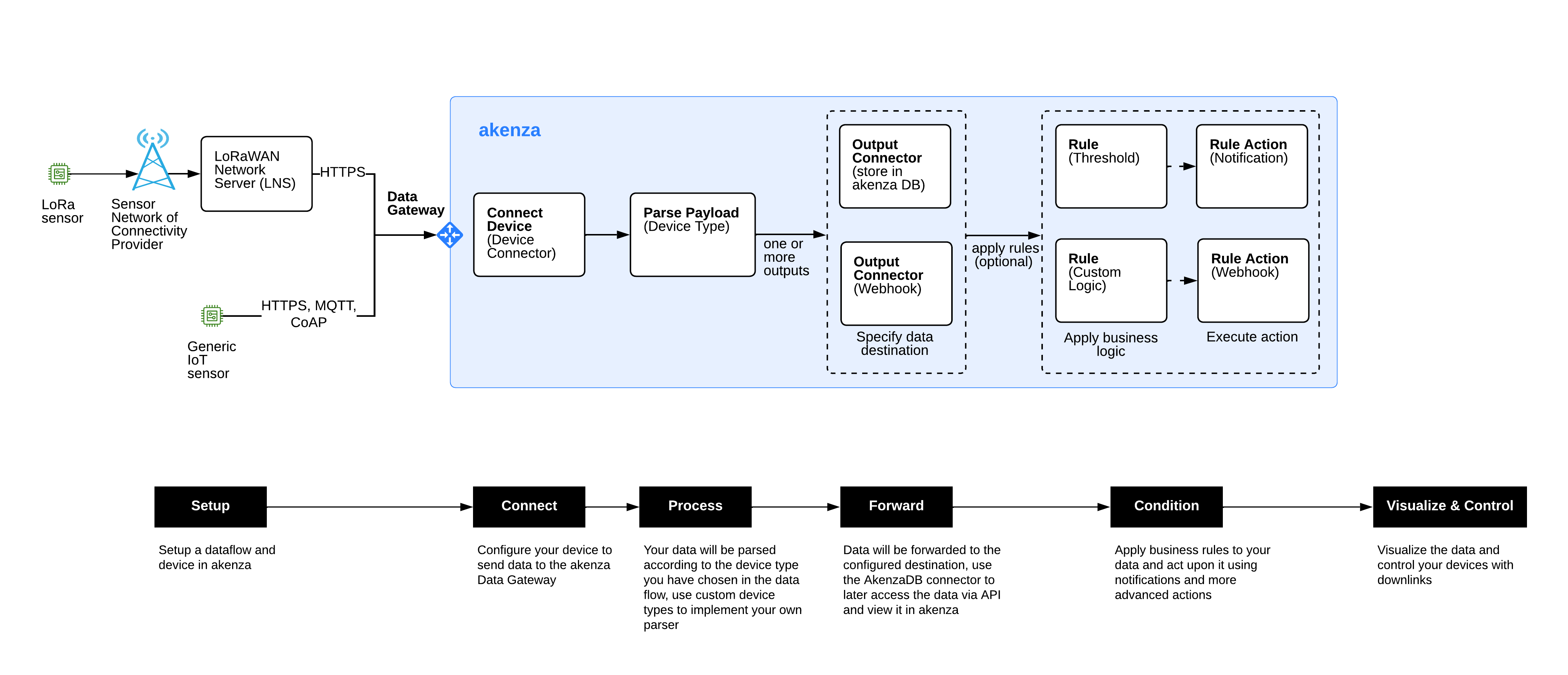
The akenza data processing pipeline is structured as follows:

<figure><img src="https://2165942204-files.gitbook.io/~/files/v0/b/gitbook-x-prod.appspot.com/o/spaces%2F-MMKXTFIN5ZlLOjBlfC4%2Fuploads%2FySrZf3w71skUKLU32HV9%2FAkenza%20Data%20Processing%20Pipeline%20-%20recharged.png?alt=media&amp;token=f52d3bf5-9e52-4c1f-b3da-08c2f9fc0bea" alt="The akenza data processing pipeline"><figcaption><p>The akenza data processing pipeline</p></figcaption></figure>

1. **Connect.** A device sends an **uplink** over its connectivity (LoRaWAN, HTTP, MQTT, CoAP, NB-IoT, mioty) or through a connected third-party cloud. The [device connector](/akenza.io/get-started/your-data-flow/device-connector.md) authenticates the message.
2. **Decode.** The [device type](/akenza.io/get-started/your-data-flow/device-type.md) parses the raw payload into structured, human-readable JSON.
3. **Process & store.** [Output connectors](/akenza.io/get-started/your-data-flow/connectors.md) write the result to akenza DB or forward it to your own database, streaming service, or webhook.
4. **Act.** The [rule engine](/akenza.io/get-started/rule-engine.md) evaluates the data and triggers notifications, downlinks, or aggregations.
5. **Visualize.** The [Dashboard Builder](/akenza.io/dashboard-builder/dashboard-builder.md) turns stored data into dashboards, signage screens, and shareable links.

## Applications

The platform is made up of four interlinked applications. You can access all of them regardless of your subscription, though some functionality is restricted to specific tiers. See [Applications](/akenza.io/general/applications.md) for details.

<table data-view="cards"><thead><tr><th></th><th></th><th></th><th data-hidden data-card-target data-type="content-ref"></th></tr></thead><tbody><tr><td><i class="fa-microchip">:microchip:</i></td><td><strong>Device Management</strong></td><td>Manage connectivity, devices, data flows, business logic, and users.</td><td><a href="/akenza.io/get-started/create-new-device.md">Devices</a></td></tr><tr><td><i class="fa-chart-line">:chart-line:</i></td><td><strong>Dashboard Builder</strong></td><td>Build data-driven dashboards, share them via public links, and run signage screens.</td><td><a href="/akenza.io/dashboard-builder/dashboard-builder.md">Overview</a></td></tr><tr><td><i class="fa-comments">:comments:</i></td><td><strong>Genio</strong></td><td>Ask questions about your IoT data in natural language and get contextual answers.</td><td><a href="/akenza.io/genio/genio.md">Overview</a></td></tr><tr><td><i class="fa-qrcode">:qrcode:</i></td><td><strong>Device Setup Assistant</strong></td><td>Roll out devices at scale with QR-code scanning and guided, on-site configuration.</td><td><a href="/akenza.io/device-setup-assistant/device-setup-assistant.md">Overview</a></td></tr></tbody></table>

## Platform capabilities

### Device Management

Full control over all your assets at any time. Device management supports every phase of the device lifecycle and offers a comprehensive set of features to manage your fleet at scale: an [asset inventory](/akenza.io/get-started/create-new-device.md) with [custom fields](/akenza.io/get-started/your-organization/how-to-use-custom-fields-on-akenza.md) and [tags](/akenza.io/get-started/your-organization/how-to-use-tags-on-akenza.md), [bulk import and bulk actions](/akenza.io/get-started/create-new-device/asset-bulk-import.md), per-device message history, signal quality and battery monitoring, and [device lifecycle reports](/akenza.io/get-started/your-organization/general-settings/device-lifecycle-notifications.md).

### Connectivity Management

[Connectivity integrations](/akenza.io/get-started/your-data-flow/device-connector/lorawan/your-integration.md) let you integrate and manage devices from different connectivity providers, such as Swisscom LPN, Loriot, Actility, ChirpStack, or The Things Network, so that existing deployments can be operated alongside new ones from a single point.

The [**Connectivity-as-a-Service**](https://akenza.io/features/connectivity-as-a-service) offering additionally lets you onboard devices without establishing a contract with a network provider.

### Data Processing <a href="#systemoverview-datagateway" id="systemoverview-datagateway"></a>

[Data flows](/akenza.io/get-started/your-data-flow.md) let you configure a complete data processing pipeline once and then apply it to any device in your fleet. akenza makes sure data is reliably decoded, processed, and forwarded or stored. Payload decoding and encoding can use a [device type from the library](/akenza.io/get-started/your-data-flow/device-type/library.md) or your own [custom scripts](/akenza.io/get-started/your-data-flow/device-type/device-type/scripting.md).

### Connectors & Storage <a href="#systemoverview-storage" id="systemoverview-storage"></a>

[Output connectors](/akenza.io/get-started/your-data-flow/connectors.md) specify the destination of your data and store it for future use: akenza DB, [InfluxDB](/akenza.io/get-started/your-data-flow/connectors/databases/influxdb.md), [SQL databases](/akenza.io/get-started/your-data-flow/connectors/databases/sql-databases.md), and [Snowflake](/akenza.io/get-started/your-data-flow/connectors/databases/snowflake.md), or streaming targets such as [webhooks](/akenza.io/get-started/your-data-flow/connectors/streaming/webhook.md), [Azure IoT Hub](/akenza.io/get-started/your-data-flow/connectors/streaming/azure-iot-hub.md), [AWS Kinesis](/akenza.io/get-started/your-data-flow/connectors/streaming/aws-kinesis.md), [Google Cloud Pub/Sub](/akenza.io/get-started/your-data-flow/connectors/streaming/google-cloud-pub-sub.md), and [Apache Kafka](/akenza.io/get-started/your-data-flow/connectors/streaming/apache-kafka.md).

### Rule Engine <a href="#systemoverview-ruleengine" id="systemoverview-ruleengine"></a>

With the [rule engine](/akenza.io/get-started/rule-engine.md) you can analyze and process data from multiple devices simultaneously and trigger actions when needed. Actions include sending SMS or email notifications, posting to Slack or Microsoft Teams, sending downlinks, and aggregating your data.

### Data Fusion Layer

The [Data Fusion Layer](/akenza.io/data-fusion-layer/data-fusion-layer.md) normalizes telemetry from multi-vendor devices into a standardized digital twin based on a tailored subset of the Brick Schema ontology, so that data is available in its spatial context of sites, floors, zones, and assets, rather than as isolated device silos.

### Akenza Building Edge

[Akenza Building Edge](/akenza.io/akenza-building-edge/akenza-building-edge.md) connects building management systems directly to akenza, bringing existing BMS data into the same pipeline as your IoT devices.

## Key concepts

<details>

<summary>Device</summary>

A device (a "thing") represents deployed hardware in the field, capable of connecting to the internet via a supported **connectivity**. Devices send data via **uplinks** and optionally receive commands via **downlinks**. They are managed in the [asset inventory](/akenza.io/get-started/create-new-device.md).

</details>

<details>

<summary>Data, topics, and samples</summary>

All data is sent from devices to the cloud, usually telemetry and state, such as environment measurements. Devices typically send data either interval- or event-based. Each uplink triggers the data processing pipeline specified by a data flow.

Data can be partitioned into **topics** based on its purpose or schema, which helps retain the structure of the data. A single data point is called a **sample** and is uniquely identified by device ID, topic, and timestamp.

</details>

<details>

<summary>Connectivity</summary>

The communication protocol a device uses to reach akenza: [**LoRaWAN**](/akenza.io/get-started/your-data-flow/device-connector/lorawan.md), [**HTTP**](/akenza.io/get-started/your-data-flow/device-connector/http.md), [**MQTT**](/akenza.io/get-started/your-data-flow/device-connector/mqtt.md), [**CoAP**](/akenza.io/get-started/your-data-flow/device-connector/coap.md), [**NB-IoT**](/akenza.io/get-started/your-data-flow/device-connector/nb-iot.md), or [**mioty**](/akenza.io/get-started/your-data-flow/device-connector/mioty.md). Devices living in a vendor cloud, such as Disruptive Technologies, VergeSense, Spaceti, or Haltian, are connected through their respective [device connectors](/akenza.io/get-started/your-data-flow/device-connector.md).

</details>

<details>

<summary>Integrations</summary>

[Integrations](/akenza.io/get-started/your-data-flow/device-connector/lorawan/your-integration.md) allow managing devices of connectivity providers (for example Swisscom LPN, Loriot, Actility, or The Things Network). This lets you integrate with existing IoT deployments and manage all assets from a single point.

</details>

<details>

<summary>Data flow</summary>

A [data flow](/akenza.io/get-started/your-data-flow.md) defines the data processing pipeline:

* [**Device connector**](/akenza.io/get-started/your-data-flow/device-connector.md) specifies the connectivity used to connect a device
* [**Device type**](/akenza.io/get-started/your-data-flow/device-type.md) specifies the type of device and implements payload decoding and encoding
* [**Output connectors**](/akenza.io/get-started/your-data-flow/connectors.md) specify one or multiple data destinations

</details>

<details>

<summary>Downlink</summary>

[Downlinks](/akenza.io/get-started/your-data-flow/device-type/device-type/downlink.md) are commands sent to a physical device (actuator or sensor) to either configure it, for example its sending interval, or trigger an action, such as turning on the lights or closing the blinds. Downlinks are supported for **LoRaWAN**, **NB-IoT**, and **MQTT** devices.

</details>

<details>

<summary>Rules</summary>

[Rules](/akenza.io/get-started/rule-engine.md) apply business logic to incoming data in order to trigger actions or alarm notifications.

</details>

<details>

<summary>Output connectors &#x26; rule actions</summary>

[Output connectors](/akenza.io/get-started/your-data-flow/connectors.md) specify the data destination for a data flow, while [rule actions](/akenza.io/get-started/rule-engine/rule-actions.md) are the response to a triggered rule. Examples include storing data with the akenza DB connector and sending notifications by email.

</details>

<details>

<summary>Organizations &#x26; workspaces</summary>

An [organization](/akenza.io/get-started/managing-an-organization.md) is the account under which a business collaborates across many workspaces. A [workspace](/akenza.io/get-started/your-organization.md) is where the actual work happens: adding data flows and rules, and managing devices.

</details>

## Keep going

<table data-view="cards"><thead><tr><th></th><th></th><th></th><th data-hidden data-card-target data-type="content-ref"></th></tr></thead><tbody><tr><td><i class="fa-graduation-cap">:graduation-cap:</i></td><td><strong>Tutorials</strong></td><td>Step-by-step guides for specific devices, notifications, and enterprise integrations.</td><td><a href="/akenza.io/tutorials/add-devices.md">Devices</a></td></tr><tr><td><i class="fa-clock-rotate-left">:clock-rotate-left:</i></td><td><strong>Changelog</strong></td><td>What's new in akenza, release by release.</td><td><a href="/akenza.io/changelog.md">Changelog</a></td></tr><tr><td><i class="fa-life-ring">:life-ring:</i></td><td><strong>Support Center</strong></td><td>FAQ, status page, service desk, and feature requests.</td><td><a href="/akenza.io/faq/support-center.md">FAQ</a></td></tr></tbody></table>


---

# Agent Instructions
This documentation is published with GitBook. GitBook is the documentation platform designed so that both humans and AI agents can read, navigate, and reason over technical content effectively. Learn more at gitbook.com.

## Querying This Documentation
If you need additional information that is not directly available in this page, you can query the documentation dynamically by asking a question.

Perform an HTTP GET request on the current page URL with the `ask` query parameter, and the optional `goal` query parameter:

```
GET https://docs.akenza.io/akenza.io/readme.md?ask=<question>&goal=<endgoal>
```

`ask` is the immediate question: it should be specific, self-contained, and written in natural language.
`goal` is optional and describes the broader end goal you are ultimately trying to accomplish on behalf of the user. GitBook uses it to tailor the answer towards what is most useful for that goal.

The response will contain a direct answer to the question and relevant excerpts and sources from the documentation.

Use this mechanism when the answer is not explicitly present in the current page, you need clarification or additional context, or you want to retrieve related documentation sections.